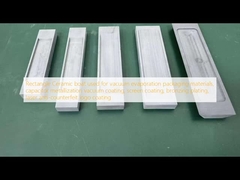
Brief: Watch as we walk through the full process, from initial setup to real-world testing of Black / Gray Silicon Nitride Ceramics. This video demonstrates their exceptional high compressive strength, fracture toughness, and performance in demanding industrial applications like precision bearings and automotive components.
Related Product Features:
Silicon Nitride Ceramics offer a high compressive strength of 3800 MPa for reliable performance under heavy loads.
These ceramics feature a fracture toughness of 6.1 MPa, ensuring resistance to cracking in extreme conditions.
With a density of 3.2 G/cm3, they provide a lightweight yet durable solution for various applications.
The bending strength exceeds 750 MPa, allowing them to withstand significant mechanical stress.
A hardness of 14.9 GPa contributes to superior wear resistance and longevity.
They possess a Poisson's Ratio of 0.27, maintaining structural integrity under elastic deformation.
The dielectric strength of 18-20 KV/mm makes them suitable for high-voltage electrical insulation.
Available in black or gray, these ceramics are ideal for precision components in automotive and semiconductor industries.
FAQs:
What are the key mechanical properties of Silicon Nitride Ceramics?
Key properties include a compressive strength of 3800 MPa, bending strength over 750 MPa, fracture toughness of 6.1 MPa, and hardness of 14.9 GPa, ensuring durability under stress.
In which industries are Silicon Nitride Ceramics commonly used?
They are widely used in automotive for engine components, semiconductor manufacturing for wafer handling, and industrial machinery for precision bearings and valves due to their strength and thermal stability.
What is the density and how does it benefit applications?
The density is 3.2 G/cm3, providing a lightweight material that does not compromise on strength, ideal for applications where weight reduction is crucial.
Are Silicon Nitride Ceramics suitable for electrical applications?
Yes, with a dielectric strength of 18-20 KV/mm, they offer excellent electrical insulation, making them reliable for high-voltage environments.